

In a world of instant-gratification and resources at our fingertips, it’s tempting to ask, “how long until I become fluent?”. We’re impatient and want to look for the easy way to fluency. We look at people on the internet who seem to speak so fluently and effortlessly and wonder what’s the fastest way to reach their level, without seeing the hard work they’ve put in and struggles they’ve been through.
Asking how long until you’re fluent is the wrong mindset to have. A better approach would be to consider which actionable steps you can take to achieve fluency. Everyone works at a different pace. What’s easy for one person (e.g. learning vocabulary) might be a headache to someone else. Perhaps you’re excellent at grasping complex grammar structures but you struggle with pronunciation.
There’s unfortunately no cookie-cutter route to fluency that works for everyone. Language learning is a lifelong journey! In fact, you don’t even know all the words that exist in your native language, so how are you able to measure an amount that you can consider fluent in a language?
Don’t let this make you lose hope though: you can reach a really good conversational level in even Japanese and Korean in just a matter of months if you put in enough time, effort, and consistency.
Consistency is really the magic ingredient here.
Any language is tricky from the start. But with the right resources, motivation, and dedication, it’s completely possible to reach a conversational level within a year or two. The more you expose your ears to Korean and practice talking, the more natural your pronunciation will become. Every minute you spend learning Korean either passively or actively will speed up your path to fluency. Don’t underestimate the importance of every minute in the day of Korean immersion.
If you are studying for ten minutes a day, every day for months on end, you’re going to improve faster than somebody who only does two hours of studying on the weekends, and doesn’t touch the language on weekdays.
I started learning Korean in 2009. That’s pretty much 10 years of learning, and there are still things that I struggled to understand, like watching the news, or talking about politics. But I consider myself near fluent because if I were to be taken via a teleportation machine and plonked in the middle of rural Korea, I’d definitely be able to help myself around. Fluency is defined differently by different people, to you, it may mean being able to help yourself out in Korean, with daily life tasks.
For others, it might mean being able to read academic papers. Start thinking about what your goal in a language is and what you personally define as fluency.
Hint: Don’t be fooled by articles and videos that tell you you can be fluent in one week of insane immersion, or a few months. I have a bone to pick with those people and made an entire video about it here. You can certainly get a good grasp of the basics or even become conversational in months, but fluency can take much longer.
When I attended the Polyglot Conference in Japan in October 2019, I remember feeling moved by something Steve Kaufman said during his speech. He said that he considers fluency to be the difference between “What you were able to say before, and what you are able to say now”. What a freeing thought!
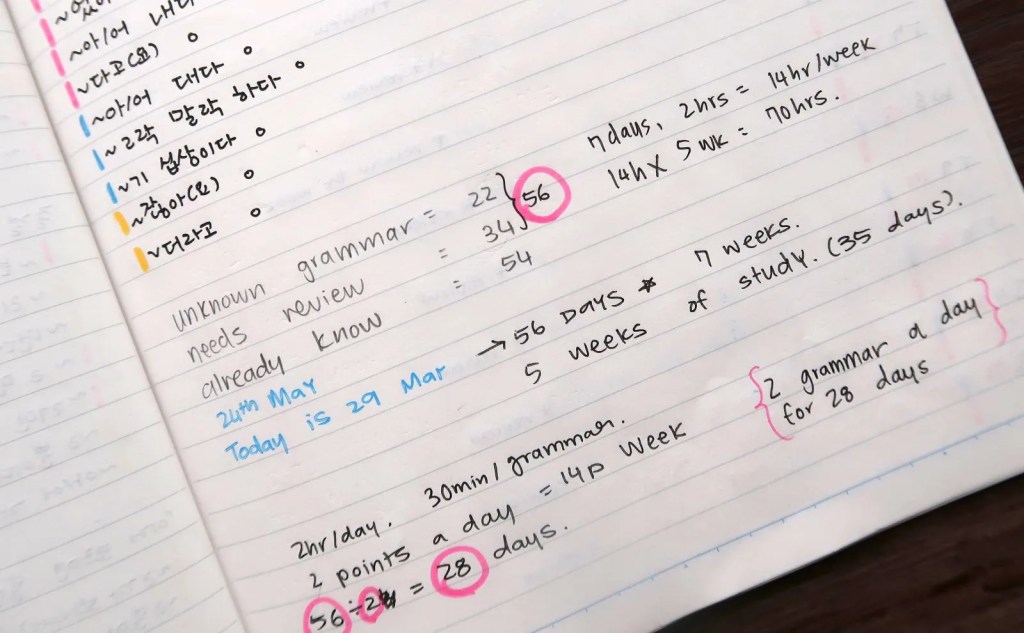
This is why it’s really important to track your language learning progress to remind yourself of the progress you’ve made and to see that you are taking steps towards fluency, whatever it means for you.
The science behind language acquisition
Contrary to popular belief that one needs to start young to learn a language to fluency, research shows that adults actually have some advantages over children when learning a new language. While children may eventually sound more native-like, adults can learn grammar rules and vocabulary more efficiently due to their developed cognitive abilities. The Foreign Service Institute (FSI) categorizes languages based on difficulty for English speakers, estimating 575–600 hours for Category I languages (like Spanish or French) and up to 2,200 hours for Category IV languages (like Korean, Japanese, or Arabic).
But these are just averages. Your timeline will depend on a few factors, according to my experiences:
- Your native language and its similarity to your target language
- Your previous language learning experience
- How immersed you can be in the language daily
- The quality and consistency of your study methods
- Your motivation and emotional connection to the language
- How much speaking practice you get with native speakers
- The diversity of your resources and methods
Four stages of language proficiency
Instead of focusing on an arbitrary timeline to fluency, consider these four general stages that most language learners progress through:
1. Beginner (0–12 months) During this phase, you’ll learn basic phrases, greetings, and simple grammar structures. You’ll feel excited by quick progress, but conversations will still be challenging. This is when many people give up, not realizing that this initial struggle is completely normal.
2. Intermediate plateau (1–3 years) This is where the infamous “plateau” happens. You know enough to have simple conversations, but complex discussions feel out of reach. Progress seems to slow down, and motivation might wane. This is when consistency becomes crucial — keep pushing through even when you don’t feel like you’re improving. Here is an article about how to break through the intermediate plateau.
3. Breakthrough to advanced (3–5 years) With persistent study and practice, you’ll start to break through. You can now express complex thoughts, understand most conversations, and consume native content with reasonable comprehension. This is when many learners start to feel confident in their abilities.
4. Refined fluency (5+ years) At this stage, you’re comfortable in nearly all situations in your target language. You can understand cultural nuances, humor, and can express yourself with precision. But even here, there will always be room for improvement — just as there is in your native language!
Language learning methods that work

It is important to create a daily language learning routine. In my decade of Korean learning and from observing thousands of language learners, these approaches consistently deliver results:
- Daily immersion: Even if it’s just 20 minutes, regular exposure beats occasional cramming. Listen to podcasts during your commute, change your phone language, watch shows with dual-language subtitles.
- Focus on high-frequency vocabulary: The 1,000 most common words typically cover about 80% of everyday conversation. Target these first before specializing.
- Find your community and tutors: Whether online or in-person, having practice partners makes a tremendous difference in maintaining motivation and improving conversation skills. You can find language partners on apps like HelloTalk, Tandem, or even language teaching/learning websites like italki. Get $10 italki credits after your first lesson with a tutor using this link!
- Embrace mistakes: The learners who progress fastest are those who are willing to sound silly and make errors. Each correction is a learning opportunity. From my experience, making a mistake solidifies the experience so much in my mind that I’ll always remember the right way to say something after that!
- Personalize your learning: If textbooks bore you, try language exchange apps. If grammar drills aren’t for you, learn through music or movies and translate lines. The best method is the one you’ll stick with. I have lots of videos on my YouTube channel that go into methods and resources that can help you create a language routine that works for you.
Remember that language learning isn’t linear! And it takes years to really reach proficiency, because you’ll always have new things to learn no matter how long you’ve been going at it. You’ll have breakthroughs followed by periods where you feel stuck. This is normal and happens to everyone, including myself and other polyglots who make it look effortless on YouTube. It’s not an easy, smooth journey.
So, the question isn’t “How long until I’m fluent?” but rather “How can I enjoy this journey while making consistent progress towards fluency?” Language learning is ultimately about connection: to people, cultures, and new ways of seeing the world and yourself.
Every conversation, every mistake, every moment of breakthrough is worth celebrating. You’re getting closer to fluency with every day you practice!
More links
Read more blog posts on my website.
Book a coaching call with me to kick off your learning journey!
Lindie Botes




 Lingolette Blog
Leave a comment